
Thanks to Rob (@Recast_Rob) for the idea for this week’s topic.
To the inexperienced- closing the deal can be one of the most difficult parts of the sales cycle. When should you ask for the purchase? How can you accurately predict which deals will close and when? What do you actually need to say to close the deal? How can you become the legendary sales closer you think you can be?
First, let’s back up. What you do to close depends on what you did to qualify. Are you talking to the right person (better be at least a key influencer)? Does the person you’re talking to have the budget for what you’re selling? Does your customer understand and agree with the value of what you’re selling? What business pain or business need are you satisfying?
 If you don’t know the answer to these questions, you will have no way of making a data-driven business prediction about how, where, when, or why your customer will buy. Read up more on qualifying here. Poor salespeople rely on a tricks, schemes, or psuedo-strategies rather than qualifying to wrangle customers into buying.
Let’s assume that you’re a smart salesperson, and you know all that you need to know (or at least the vast majority of it). Here’s how to make a decision of how, when, and through what medium you should ask for the close:
Step 1: Review what you know with your customer.
Confirming what you know does two important things. First- it let’s you make sure you’re correct about any assumptions you’ve made. Second (and more importantly)- it lays a foundation in your customer’s mind for what you are about to ask for. Talk through your previous conversations, the different solutions you presented and why, and what you selected together as the best option (hint: if you didn’t do this, you’re putting your deal in danger). Address any lingering questions your customer may have. Remember- good salespeople don’t sell just for commission dollars- they sell because they genuinely want to help. Don’t be a scumbag.
Step 2: Confirm again that you both agree on the solution.

This seems obvious, but it’s something a lot of salespeople skip. You’ve discussed and selected a solution together- time to make sure that still holds true. If it doesn’t- go back to qualifying and working to understand what stands in the way (take your time to truly address any remaining issues). Only move forward once you both agree that you’ve found the right solution. Once you have- the final step should be very easy.
Step 3: Ask for the close.
This is a very simple task, that will give you valuable info immediately. I currently work in the B2B space, so for me it could be something as simple as “When can I expect your purchase order?” When I was in retail- I said something like “Are you ready? I can ring you up over here.” However you decide to say it, ask for the sale either verbally or in writing. This does three things:
- Brings any remaining objections or concerns into the spotlight so they can be addressed immediately. Usually this is the one your customer has been hiding because they think you won’t be able to address it properly. This is your opportunity to solidify a business relationship for a long time to come.
- Let’s you judge your qualifying work. The smaller the issues that stand in the way, the better of a job you did at qualifying. The bigger the issues, the more work you need. Constantly judge your own work and work to improve.
- Gives your customer no excuses if you’ve done your job right. When you present someone in the right position a solution to a real problem they are ready and able to fix, and you both agree that it is the right solution- closing is easy.
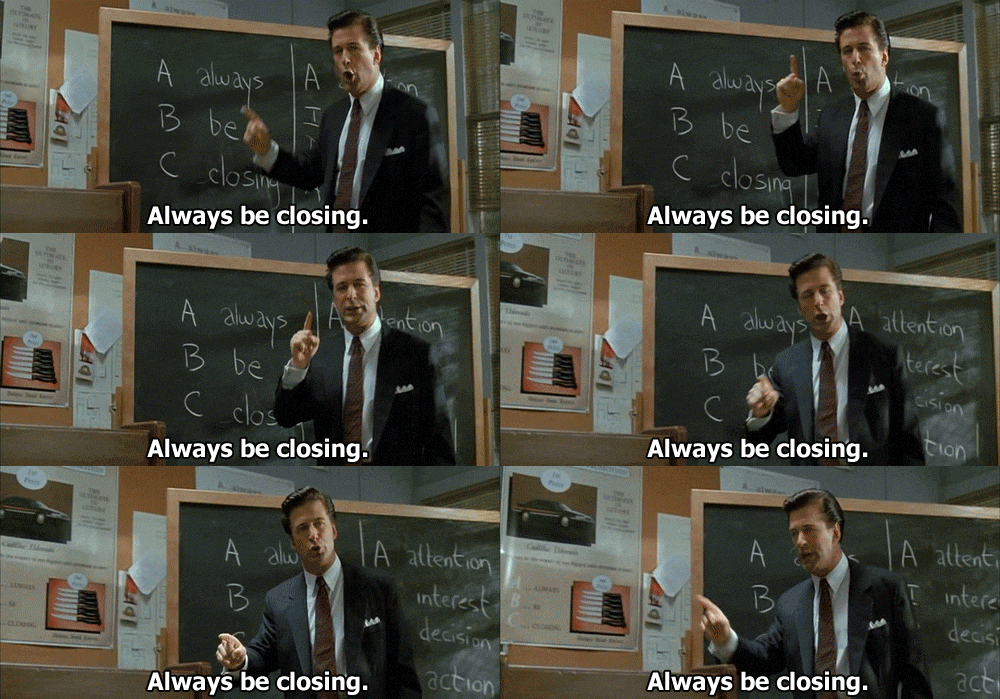
I can’t stress enough the importance of setting up this process from the beginning. Qualifying and keeping a consultative approach with honest, open communication leads to easy closes. Trying to trick, mislead, or even just being lazy about qualifying causes last minute concerns and a higher percentage of losses. Douche-y Alec Baldwin is right- you should always be thinking about what’s left before you can close.
Good luck out there!

 Christian McCall